- Published - 10 - February - 2026
What is Patta and Its Importance for Property Owners?
- What is Patta?
- Why is Patta Important for Property Owners in Chennai?
- Types of Patta in Tamil Nadu
- Difference Between Patta and Chitta
- Is Patta Mandatory for All Properties in Chennai?
- How to Apply for Patta in Chennai?
- Common Patta Issues Faced by Property Owners
- Importance of Patta Verification Before Buying Property in Chennai
- Need Help with Patta or Land Approvals?
- Frequently Asked Questions (FAQ)
What is Patta?
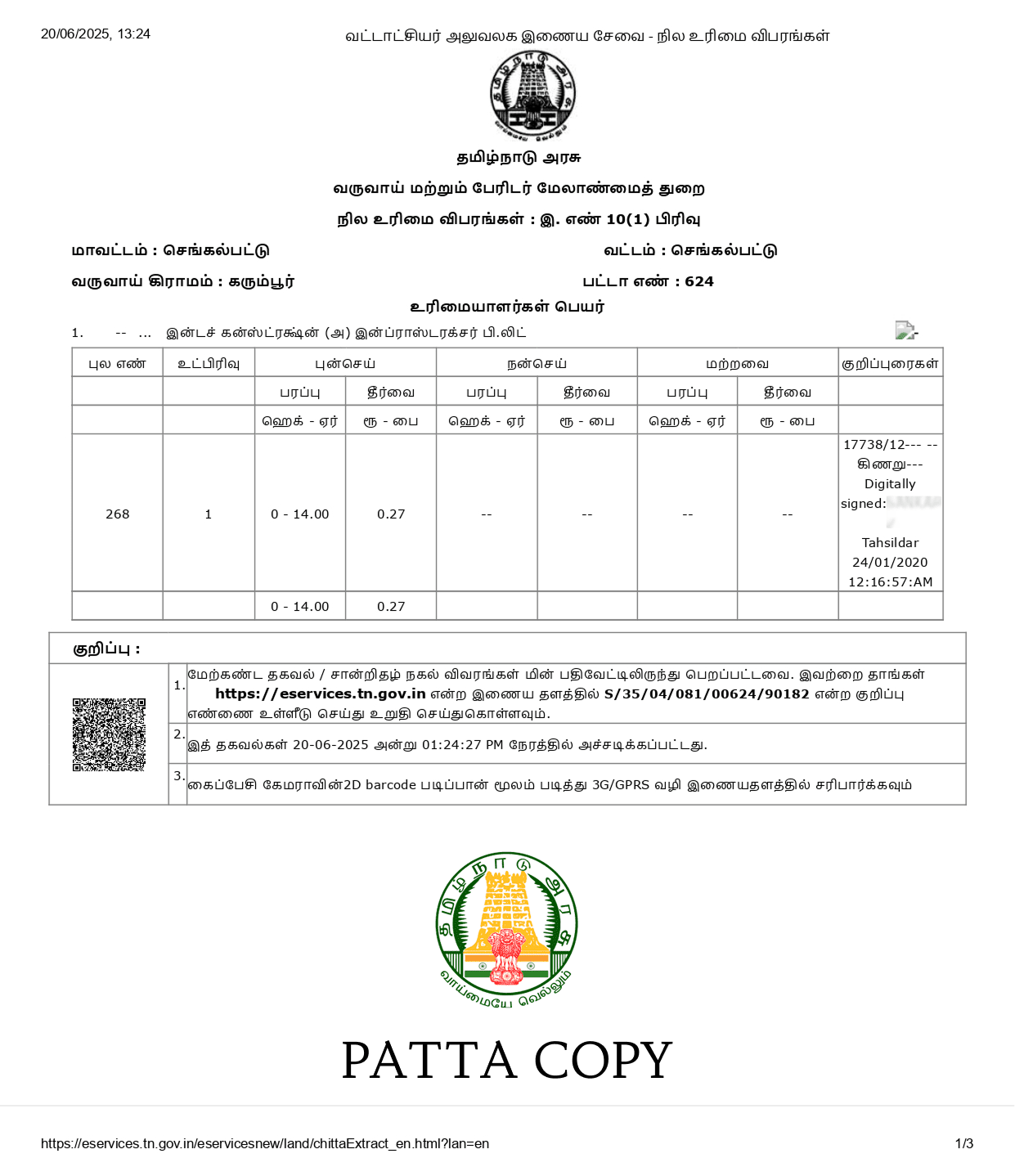
A Patta is a legal land ownership document issued by the Revenue Department of the Government of Tamil Nadu. It records details about the land and identifies the rightful owner.
In simple terms, Patta acts as proof that a particular piece of land belongs to a specific person or entity.
Information Mentioned in a Patta
A Patta usually contains:
Owner’s name
Patta number
Survey number and sub-division
District, Taluk, Village details
Land type (wet land / dry land)
Total land area
Why is Patta Important for Property Owners in Chennai?
1. Legal Proof of Ownership
Patta is one of the most important documents to prove legal ownership of land. Without a Patta, claiming ownership can become difficult during disputes.
2. Mandatory for Property Registration
In Chennai and across Tamil Nadu, a valid Patta is required during:
Sale or purchase of land
Property registration
Transfer of ownership
Without Patta, property registration may face objections or rejection.
3. Required for Building & Layout Approvals
Authorities like DTCP, CMDA, and local bodies often require Patta while processing:
Land approvals
Layout approvals
Building plan approvals
A missing or incorrect Patta can delay approvals significantly.
4. Helps Avoid Legal Disputes
Patta helps:
Identify the rightful landowner
Prevent boundary disputes
Avoid issues related to encroachments or overlapping claims
For Chennai properties, where land values are high, Patta plays a vital role in legal safety.
5. Necessary for Land Conversion
If you plan to convert land from agricultural to non-agricultural, Patta details are verified during the land conversion process.
6. Essential for Loans & Financial Transactions
Banks and financial institutions require Patta when:
Applying for home loans
Applying for land loans
Mortgaging property
A clear Patta improves loan approval chances.
7. Required for Property Tax Assessment
Local bodies use Patta details to:
Assess property tax
Update ownership records
Incorrect Patta details can lead to tax-related complications.
Types of Patta in Tamil Nadu
1. Individual Patta
Issued when the land is owned by a single person.
2. Joint Patta
Issued when land is owned by multiple individuals, such as family members or partners.
3. Patta for Agricultural Land
Issued for land classified as wet land or dry land, mainly used for farming purposes.
4. Patta for Non-Agricultural Land
Issued for residential, commercial, or industrial use lands after conversion approval.
Difference Between Patta and Chitta
| Patta | Chitta |
|---|---|
| Shows ownership details | Shows land classification |
| Issued by Revenue Dept. | Issued by Village Administrative Officer |
| Contains owner name | Contains land type (wet/dry) |
Note: In Tamil Nadu, Patta and Chitta are now issued as a combined document.
Knowing which authority applies to your plot is essential before buying.
Is Patta Mandatory for All Properties in Chennai?
Independent plots & land: Yes, Patta is mandatory
Apartments: Individual Patta may not be issued; UDS (Undivided Share) is relevant
Government land: Patta is not issued
Encroached land: No Patta is provided
Always verify Patta before purchasing any land in Chennai.
How to Apply for Patta in Chennai?
Patta can be applied through:
Taluk Office
Revenue Department
Online portal of Tamil Nadu Government
Required documents usually include:
Sale deed
EC (Encumbrance Certificate)
Identity proof
Address proof
Survey details
Approval time varies depending on verification and land classification.
Common Patta Issues Faced by Property Owners
Wrong survey number
Boundary mismatch
Joint Patta disputes
Missing subdivision details
Land classified as government or water body
Professional guidance can help resolve these issues faster.
Importance of Patta Verification Before Buying Property in Chennai
Before finalizing a property purchase:
Verify Patta details
Match survey number with EC
Confirm land classification
Check ownership continuity
This ensures legal safety and peace of mind.
Conclusion
Patta is not just a document it is the foundation of legal land ownership in Chennai. Whether you are buying, selling, developing, or inheriting property, having a clear and valid Patta protects your investment and avoids future complications.
Understanding Patta and verifying it properly is a must for every property owner in Chennai.
Need Help with Patta or Land Approvals?
Brindhavanam Promoters provides professional consultancy and guidance for Patta verification, land approvals, and documentation support across Chennai and Tamil Nadu.
We are a private consultancy and not a government authority.
Frequently Asked Questions (FAQ)
Patta is a legal land ownership document issued by the Tamil Nadu Revenue Department that records details of the land and the name of the rightful owner.
Yes. Patta is mandatory for buying independent plots and land in Chennai, as it helps establish legal ownership and avoid future disputes.
Yes. A valid Patta is generally required while applying for DTCP or CMDA land, layout, and building approvals.
Buying land without Patta is risky and not advisable, as it may lead to legal complications, registration issues, or approval rejections.
Patta shows ownership details, while Chitta shows land classification (wet or dry). In Tamil Nadu, both are now issued as a single combined document.